ADA parking lot compliance in New Jersey means providing the correct number of accessible spaces with proper dimensions, slopes, signage, and a clear accessible route to the building entrance. This also includes stall sizing, access aisles, compliant striping, and unobstructed paths of travel.
Failing to meet these requirements can lead to DOJ complaints, fines up to $500 per violation under NJ law, costly restriping, and operational disruption. This guide, courtesy of our team at EB Paving, breaks down the meaning of ADA parking lot compliance in New Jersey, including how the state’s additional requirements can impact your property.
What Is ADA Parking Lot Compliance?
ADA parking lot compliance refers to providing accessible parking spaces, properly sized access aisles, and a continuous accessible route from parking to the building entrance. It applies to any business, HOA, nonprofit, or government facility in New Jersey that offers parking.
Under Title III of the ADA, barrier removal is required even if no construction is planned. This includes private parking lots. An accessible route is the shortest usable path to an entrance, free of obstructions, curbs, or steep grade changes.
New Jersey enforces both federal ADA standards and the state’s Barrier Free Subcode, which can be more strict in certain areas.
Federal ADA vs. the New Jersey Barrier Free Subcode — What NJ Property Owners Must Know
New Jersey property owners must follow a two-layer compliance system:
- Federal ADA (2010 Standards) — Enforced nationwide by the Department of Justice (DOJ)
- NJ Barrier Free Subcode (N.J.A.C. 5:23-7) — State-specific rules that may exceed federal requirements
Some key New Jersey-specific requirements include:
- Penalty signage: Each accessible space must include an R7-8P penalty sign listing fines ($250 first offense; higher penalties for repeat violations)
- Upgrades during maintenance: Resurfacing, repaving, or restriping triggers ADA compliance updates
- Municipal enforcement: Local police can issue ADA parking violations on private property
- Snow removal law: Accessible spaces must be cleared within 48 hours of snowfall
- Medical facilities: 10% of parking must be accessible in outpatient facilities
If you’re planning paving or maintenance work, treat it as a compliance update, not just a surface touch-up.
How Many Accessible Parking Spaces Are Required in New Jersey?
Accessible parking space counts in New Jersey are calculated for each individual parking lot or structure, not across an entire site. In addition, at least one out of every six accessible spaces must be van-accessible.
ADA / NJ Barrier-Free Subcode Accessible Parking Requirements
New Jersey follows the same minimum accessible parking requirements as the federal ADA:
| Total Parking Spaces | Required Accessible Spaces |
|---|---|
| 1–25 | 1 |
| 26–50 | 2 |
| 51–75 | 3 |
| 76–100 | 4 |
| 101–150 | 5 |
| 151–200 | 6 |
| 201–300 | 7 |
| 301–400 | 8 |
| 401–500 | 9 |
| 501–1,000 | 2% of total spots |
| 1,001+ | 20 + 1 per 100 over 1,000 |
A 120-space lot requires 5 accessible spaces, and at least 1 must be van-accessible.
Medical outpatient facilities in New Jersey must meet a higher standard. The NJ Barrier-Free Subcode requires that 10% of all spaces be accessible.
ADA Parking Space Dimensions and Layout Requirements
Correct space counts are only part of ADA parking lot compliance. Each space must meet strict dimensional and surface standards to be considered accessible.
Standard Accessible Stall and Access Aisle
The access aisle provides the space needed for wheelchair users and ramps to safely enter and exit vehicles. A compliant stall with an undersized aisle is still non-compliant.
- Stall width: 96 inches (8 feet) minimum
- Access aisle: 60 inches (5 feet) minimum
- Slope: Maximum 1:48 in all directions
- Surface: Firm, stable, and slip-resistant
Van-Accessible Parking Space Options
- Option 1: 132-inch stall + 60-inch aisle
- Option 2: 96-inch stall + 96-inch aisle
- Vertical clearance: 98 inches, where applicable
Accessible car spaces must be at least 96 inches wide, while van-accessible spaces must be at least 132 inches wide to align with federal ADA standards.
Access Aisle Rules
- Must run the full length of the parking space
- Must be clearly marked
- Must connect directly to an accessible route
- Can be shared between two spaces
Placement — Shortest Accessible Route
Accessible spaces must be placed along the shortest accessible route to an entrance. This route must avoid curbs, traffic lanes, and uneven surfaces.
ADA Parking Lot Striping and Marking Requirements
Even when spot dimensions are correct, unclear or faded markings can result in non-compliance.
ADA-compliant parking lot striping must:
- Clearly define stall and aisle boundaries
- Include “NO PARKING” markings in access aisles
- Use high-contrast paint for visibility
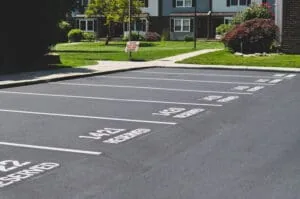
Common parking lot pavement markings include:
- Stall lines
- Hatched access aisles
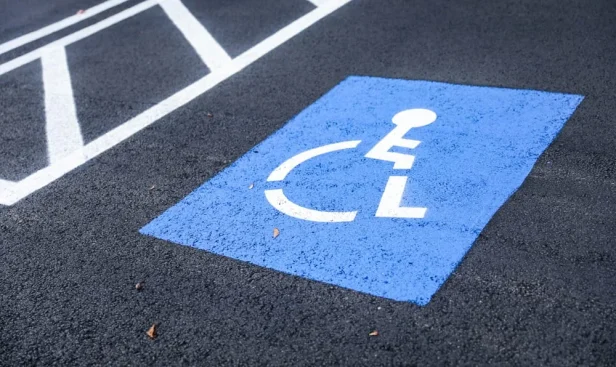
- Accessibility symbols within spaces
After sealcoating or resurfacing, measurements must be rechecked before restriping. Small layout shifts can lead to compliance issues.
Signage Requirements — What New Jersey Requires Beyond the Federal Standard
There are different ADA parking lot requirements at both the state and federal levels. Federal ADA signage requirements include:
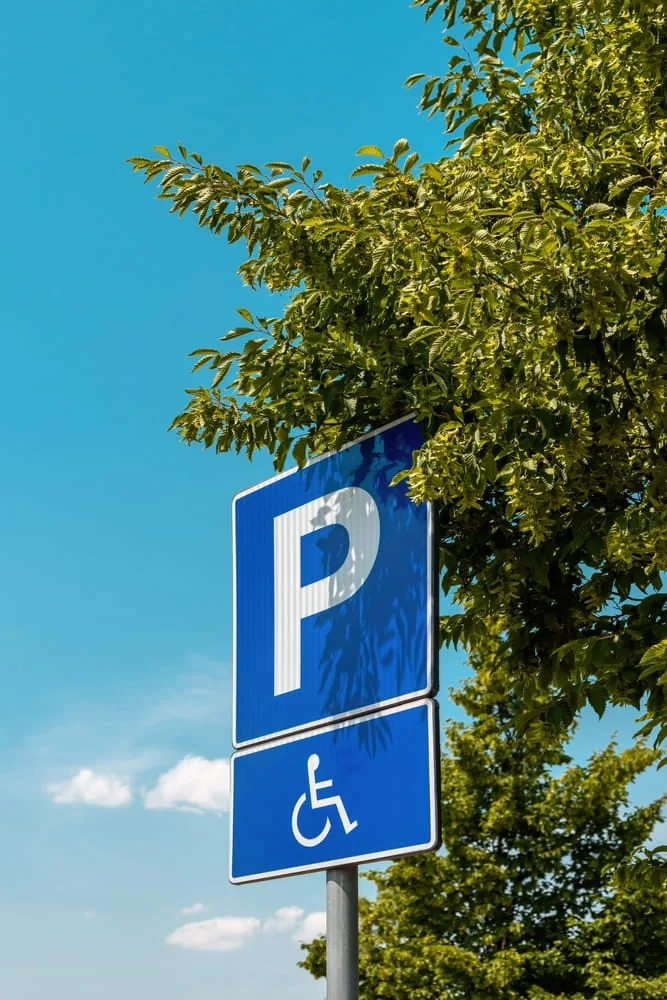
- Accessibility sign at each space
- Minimum mounting height of 60 inches
- “Van Accessible” designation where required
New Jersey adds stricter requirements, including:
- R7-8P penalty sign at every accessible space
- The sign must list fines and be mounted at the head of the space
- If the sign is perpendicular to the sidewalk, it must be mounted at 72 inches
Properties with four or fewer spaces are exempt from signage requirements but must still provide accessible parking.
Outdated signage is a common compliance issue found during inspections. If your signs were installed years ago, they may need to be updated.
Common ADA Parking Lot Compliance Mistakes in New Jersey
Most violations happen gradually as parking lots age or change over time. While they’re rarely intentional, these small slip-ups can lead to serious fines and legal repercussions.
Common ADA parking lot compliance issues include:
- Faded striping that makes aisles unclear
- Incorrect dimensions after restriping
- Slopes exceeding ADA limits
- Aisles that don’t connect to accessible routes
- Missing NJ penalty signs
- Improperly sized van spaces
- No updates after resurfacing
- Spaces blocked by snow or debris
How to Maintain ADA Parking Lot Compliance Over Time
- Restriping before markings fade
- Repairing cracks and surface damage
- Keeping accessible routes clear
- Updating safety features
- Checking signage for visibility and height
- Reverifying the layout after resurfacing
- Removing snow within 48 hours
- Scheduling periodic compliance reviews
ADA compliance should also be part of your larger parking lot maintenance plan, especially after sealcoating, resurfacing, or layout changes that require new striping.
Quick ADA Parking Lot Compliance Checklist for NJ Property Owners
- Count total spaces and calculate the required accessible spaces
- Verify stall and aisle dimensions
- Confirm slopes don’t exceed 1:48
- Place spaces along accessible routes
- Stripe aisles with clear markings
- Install required signage, including NJ penalty signs
- Ensure van-accessible spaces are properly designated
- Confirm medical facilities meet 10% requirement
- Document layout with photos
- Recheck compliance after maintenance work
EB Paving Can Help with ADA Parking Lot Compliance in New Jersey
Staying compliant with ADA parking lot requirements in New Jersey takes planning, accurate layout, and ongoing maintenance. Our team at EB Paving helps local commercial property owners avoid costly violations and keep parking lots safe and accessible.
Our services include:
- Compliance reviews of existing layouts
- ADA-compliant striping and markings
- Pavement repairs to restore accessible routes
- Sealcoating and resurfacing with compliant restriping
- Phased scheduling to reduce disruption
We serve commercial, industrial, HOA, and healthcare properties across New Jersey. This includes Edison, Toms River, Princeton, Farmingdale, Cherry Hill, Hamilton, and other service areas across New Jersey. Get in touch with us today to get a quote or schedule your next service.
FAQs About ADA Parking Lot Compliance
The number of spaces depends on the total parking spots per lot, using the standard federal ADA table. At least one of every six accessible spaces must be van-accessible. For example, a 75-space lot requires 3 accessible spaces, with at least 1 van-accessible.
Fines start at $250 for a first offense and can increase for repeat violations. Penalties may also include community service. Violations can be enforced on private property, and DOJ complaints may lead to additional costs and required corrections.
Yes. New Jersey requires an R7-8P penalty sign at each accessible space, in addition to standard ADA signage. These signs must list fines and be properly mounted at the head of each space.
Not always. Many ADA upgrades, such as striping, signage, and layout corrections, can be completed by an experienced paving contractor like EB Paving. More complex structural changes may require additional inspections.
Yes. ADA rules apply regardless of when the lot was built. In New Jersey, compliance updates are also required during resurfacing or restriping. Older lots are not exempt from current standards.